Every token has a card behind it.
HoopsPaired is a launchpad where every token is paired with one exact NBA card printing. The card gives the token its identity and a real-world price to measure itself against. This guide explains how pairings work, how to launch one, and what happens to the fees a pairing earns.
The idea
Most new tokens start with nothing to point at: no story, no benchmark, no way to tell whether a price is big or small. Graded basketball cards are the opposite. A landmark printing leaves auction records, population reports and market prices that anyone can look up.
HoopsPaired joins the two. Every token launched here is paired with one card printing from the catalogue. The card is the token's face and its benchmark: at a glance you know what the token stands for and how its market cap compares with the card it is named after.
One exact printing, recorded in the token itself: player, set, number, variant, grade and reference price.
The card's reference price, shown next to the token's market cap everywhere on HoopsPaired.
Anyone can launch a card and anyone can trade it. The market decides how much of the card's value the token reaches.
Every pairing charges 3% on buys and sells, routed to a card vault of its own instead of to the wallet that launched it.
The catalogue
Only catalogue cards can be launched. The catalogue is a curated list of 29 printings, each referenced above $303, from current rookies to the 1986 Fleer Jordan. Keeping it curated means every pairing points at a card that is well documented and has a public price.
Every entry is one exact printing: set, card number, variant and grade. That detail matters. A Flagg Topps Chrome #251 PSA 10 references $303; the Refractor parallel of the same card references $1,802. Two printings of the same player are two different cards, and two different pairings.
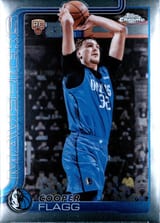
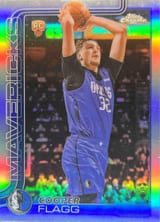
- Grail. Five figures and up in a PSA 10. Sales are rare and each one moves the price.
- Chase. One to ten thousand in a PSA 10. Silvers, refractors and the rookies the hobby is chasing.
- Modern. Rookies from the Prizm and Topps Chrome era, 2009 onward.
- Vintage. Chrome, Fleer, Finest and Stadium Club rookies from before 2009.
Each reference comes from a public source for that exact printing, named in the catalogue and on every token paired with the card:
- PriceCharting PSA 10 market price. The reference for every card at launch: the running market price for that exact printing in a PSA 10, built from completed sales. Each card page links the page it was read from.
- PSA 9 and ungraded. Shown alongside on the card page for context. They are not the benchmark.
- Grail tier review. Above five figures, sales are rare and each one moves the number, so the feed's value is checked by hand against the auction record before it changes.
The 7d column on the Cards page shows how a card's market drifted over the last week against its 30-day average. It is noisy on vintage cards that rarely sell.
The card as a yardstick
Everywhere on HoopsPaired, a token's market cap sits next to its card's reference price. The ratio between the two is the number a pairing is built around: how much of the card's value the market has priced into the token.
Take a token paired with the 1986 Fleer Jordan PSA 10, referenced at $355,000:
- At a $49,700 market cap, the token is at 14% of its card.
- At $355,000, token and card are level.
- At $710,000, the token is worth x2.0 the card.
Below its card, a token's ratio reads as a percentage; above it, as a multiple. Token pages show it under Pairing card.
The ratio moves from both sides. The token trades around the clock, while the card's reference follows auctions and market prices. Neither price sets the other, so a token can sit below its card, level with it, or far above it.
That is what makes a pairing easy to talk about. "Jordan is at 14% of the card" says more than a bare market cap, and anyone can check the card's price for themselves.
The card vault and the Slam
A benchmark on its own is not binding. A token can name a $355,000 card for the rest of its life without a single dollar ever moving toward one, and that is the honest weakness of pairing by reference alone. The vault is what makes the pairing cost something: every HoopsPaired token charges a fee on its own trades, that fee is routed to a contract belonging to that token, and that contract fires on a clock. Every fee is an assist. Every three minutes, the Slam.
What a pairing charges
Every token launched here carries the same tax, written into it at launch: 3% on a buy and 3% on a sell. It is not a per-launch choice. The launcher sets it, so one pairing cannot quietly charge more than another, and it sits on top of the 70% creator share of the 1% Pons curve fee the token already earns. Both go to the same place.
Where it goes
Pons pays a token's creator share to one address, chosen when the token is created and written into its record as creatorFeeRecipient. On HoopsPaired that address is a vault opened for that token, in the same transaction as the token itself. The launcher sets it and overwrites whatever the caller asked for, so no launch can point its fees at a wallet of its own choosing.
3% on a buy, 3% on a sell, plus the Pons creator share of the curve fee.
The token names its own vault as fee recipient. It cannot be changed afterwards.
Opened by the launch, one for every pairing. Every three minutes: one buy of the card token, one buy of the pad token, both burned.
The Slam
The fees do not sit there. Every 3 minutes, on the same clock for every card, each vault fires. One firing is three transactions, and every one of them is on the explorer:
- 01Claim
The vault sweeps everything its token has earned since the last slam: its share of the tax and its creator share of the curve or pool fee. All of it, not most of it.
- 02Two buys
90% of the ETH becomes a single buy of that card's token, one green candle into its chart on the clock. 7% becomes a single buy of $HOOPS, the pad token. 3% keeps the pad running.
- 03Burn both
What the slam just bought is burned straight away, the card token and the pad token alike. Supply drops, on-chain, and nobody can ever sell it. Nothing sits in a wallet.
- On the clock. A slam can fire once the interval has passed and never before, so nobody can bring one forward and everybody can see it coming. The countdown on every token page is the same countdown. If the keeper is down, the clock still gates the call; anyone can fire it.
- Small fees wait. Under 0.0005 ETH, the assists roll into the next slam. A failed slam retries on the next tick.
- Anyone can pull the trigger. The call is permissionless: once the clock allows it, any wallet can fire a card's slam. A keeper does it on schedule so nobody has to. If the keeper ever stops, the button still works.
- One vault per token. A pairing's fees are never mixed with another's: its vault has its own address, its own log and its own burn count, all readable from the token page.
- Nothing reaches the wallet that launched. Launching a card is not a way to earn a fee stream; it is a way to open one for the card.
The pad token and the Dunk
$HOOPS is the pad's own token, launched on Pons like every card. It is not paired with a card; it is paired with the pad. Two things feed it and both end in a burn:
- Every slam of every card. 7% of each card's fees becomes one buy of $HOOPS, burned in the same firing. More cards on the pad means more $HOOPS gone. Other people's cards fund the burn.
- Its own creator fees: the Dunk. $HOOPS earns the Pons creator share on its own trades like any token. On the same 3-minute clock, 100% of it becomes one buy of $HOOPS, burned. Not most of it. All of it.
So the loop closes on itself. Card trades feed card burns and $HOOPS burns; $HOOPS trades feed $HOOPS burns. Every leg of it is on the clock, on the explorer, and ends with supply leaving.
Who can move what it holds
Nobody. A vault holds fees only between slams, and a slam spends all of them: 90% and 7% into the two buys that get burned, 3% to the pad. There is no withdraw call and no address a balance can be sent to. Read a vault as a public record of what its pairing has earned and burned, not as a claim on anything.
Launching a card
Anyone with a wallet on Robinhood Chain can launch a card, in a single transaction.
- 01Pick a card
On the Launch page, or with Launch this card from any card in the catalogue. If the card already has a token, the registry says so and you pick another.
- 02Name it
The name and ticker are filled in from the card. Change them if you like, and add an image, your X account and website. They become public and cannot be changed after launch.
- 03Sign once
Connect a wallet on Robinhood Chain and confirm one transaction. It pays the Pons launch fee, creates the token, opens its vault and records the pairing in the registry.
- 04Share it
The token opens on its own page straight away, with the ratio post ready to send, and joins the list on the home page.
What gets written into the token
- Logo. Your image, pinned to IPFS as on any launchpad. Without one, the token uses its slab.
- Description. The tag
HoopsPaired card: <id>, then the card's player, set, number, grade and its reference price on the day of launch, with a note that the token is not redeemable for a physical card. - Links. The X account and website you added.
One token per card
An on-chain registry maps each catalogue card to the token paired with it. A second launch on a card that is taken is refused by the contract, not just the interface. Every card gets one market, so its liquidity is not split across copies.
Tokens launch on Pons V2, the token launchpad on Robinhood Chain, so supply, the launch phase and graduation at 4.2 ETH follow the same rules for every card. Nothing about the market depends on which card you pick: only the benchmark does.
What this is not
- Not fractional ownership. No token represents a share of any card, and no card is held on anyone's behalf.
- Not custody. No physical cards, no vault of slabs, no shipping. The card itself never moves.
- Not a promise. No payout, yield or return is stated or implied. The vault buys back; holders are owed nothing.
- Not an investment. No token confers ownership, a fractional interest, a redemption right, or any claim on a card, a vault, ETH, or HoopsPaired. HoopsPaired takes a stated fee on slams and does not use anyone's purchase money to build anything for them.
- Not affiliated. HoopsPaired has no relationship with the NBA, the NBPA, any player, Topps, Fanatics, Panini, PSA, PriceCharting or SportsCardsPro, and is not affiliated with, endorsed by, or officially connected with Robinhood Markets, Inc. or Pons Labs. Card names, set details and grades are factual references, like a price guide. Card scans identify the printing; the artwork and marks belong to their owners. Price data is cited to and linked from its source.
- Not everywhere. Tokens launch on Pons, whose terms exclude the United Kingdom, the European Union and sanctioned jurisdictions. HoopsPaired is not offered to people there. Pons V2 is under audit review and has no closed audit; treat it as unaudited.
Reference prices are PSA 10 market prices from PriceCharting at the time shown and are refreshed by the price feed. Card scans and artwork belong to Topps, Panini and the NBA; they are shown to identify the printing. HoopsPaired is not financial advice. Read the catalogue for each card's source.